
Wholesale Reusable Bags for Grocery Stores | Compliance + Specs | Wovenary
Wholesale reusable bags for grocery and convenience retailers. NWPP, BOPP, canvas — bag-law compliant in 12 states. MOQ 1,000, ex-factory from $0.45. Real customer data inside.
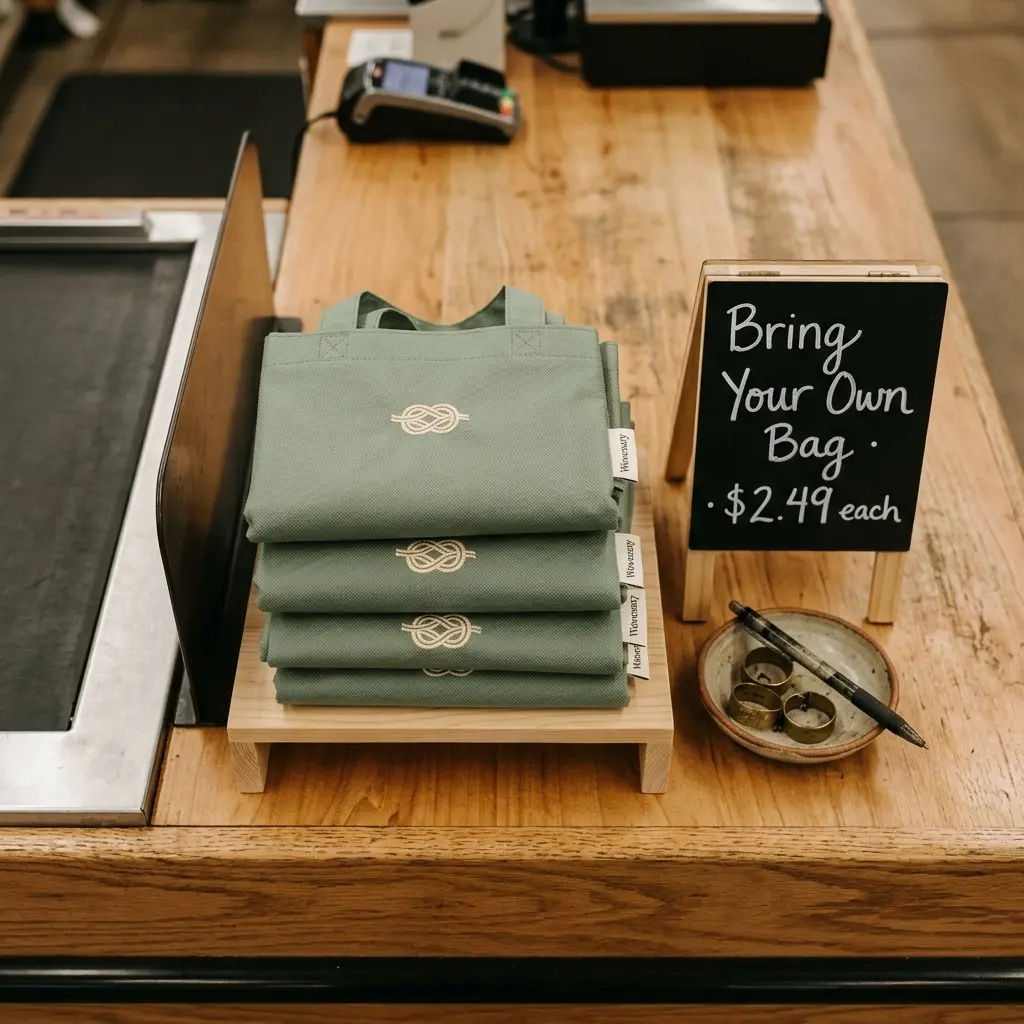
Most grocery and convenience retailers should source 100 GSM stitched non-woven polypropylene totes at $0.65–$0.95 landed DDP, sell them at the register at $1.99–$2.99 as a merchandise SKU, and use the margin to fund a modest customer-loyalty program. MOQs by material: canvas 100; non-woven and laminated BOPP 1,000. Lead time 7–9 weeks first cycle, 5–10 days on reorder when we pre-stage inventory.
Where grocery checkout law actually bites
Twelve states plus a layer of major cities have active checkout-bag rules in 2026. The cheat sheet we hand to grocery procurement during the first call:
| State / City | Law | Rule in plain English |
|---|---|---|
| California | SB 1053 + LA County 12.85 | Plastic banned. 10¢ paper. 125-use reusable, heavy-metal certs. |
| New York | ECL § 27-2801 + NYC Local Law 2019/100 | Plastic banned. NYC 5¢ paper. 80 GSM reusable. |
| Illinois (Chicago) | Chicago MCC Ch. 3-50 | No outright ban. 15¢ checkout tax on every bag (2026). |
| Pennsylvania (Philly) | Phila. Code 9-4900 + Bill #250773 | Plastic banned. 10¢ paper + reusable fee at checkout (Jan 2026). |
| Massachusetts (Boston) | Boston MC Ch. 17-19 | No statewide ban. Boston handled-bag spec. |
| Maryland (MoCo) | MoCo BYOB Law | Plastic banned in adopting munis. 10¢ paper. |
For the full per-jurisdiction breakdown use the ban finder. Last reviewed May 2026.
The merchandise model: why selling beats giving away
The math we run with every grocery customer at the first meeting: a $0.85-landed reusable tote sold at $2.49 yields $1.64 gross margin per unit. A typical mid-size regional chain with 90 stores moving 50 reusables per store per day at that margin generates roughly $200,000 in incremental margin per store annually on top of avoided per-bag fee friction.
The model only fails when the retail price drops too low ($1.00 retail kills the margin) or the bag doesn't carry brand value worth $2.00 in the customer's hand. The fix on both sides is the same: spec the right bag and price it correctly. We help customers calibrate both during the quote — the conversation typically runs 30 minutes and ends with a per-SKU recommendation.
Grocery procurement facts at a glance
Spec floor. A compliant grocery checkout reusable in 2026 has stitched handles, ≥80 GSM woven or non-woven PP (or 12oz+ cotton canvas), 125-use lifetime per most state spec, and an affixed tag listing manufacturer / country of origin / heavy-metal-free statement / post-consumer recycled content. Wovenary bags ship pre-verified across these spec lines.
Lead time. First-cycle 7-9 weeks (3-4 weeks production + 4-5 weeks ocean freight to East Coast; 3 weeks to West Coast). Reorder cycles drop to 5-10 days when blank inventory is pre-staged at our Bethesda warehouse. National chains typically run regional rollouts staggered by DC over 90-120 days.
Order economics. On a 25,000-unit grocery order of 100 GSM stitched non-woven PP totes with one-color screen print: factory cost $0.42-$0.48 FOB, ocean freight $0.18, duty (5% MFN from Pakistan) $0.02, allocated Wovenary US overhead $0.10, landed DDP $0.72-$0.78. Retailer sell-through at $2.49 yields $1.71 gross margin per unit, or $42,750 on the order.
Brief us on your grocery reusable program
We review grocery RFQs and prepare a full landed-cost breakout, per-state compliance documentation, and a reorder cadence proposal sized to your store count.
— Annem Zaidi, Co-founder, Wovenary
Frequently asked questions
What bag style do most grocery customers actually order?
What MOQ and lead time should grocery procurement plan around?
Should grocery sell reusables at the register or give them away?
Which states require what for grocery checkout in 2026?
Do you supply national grocery chains?
How much does a grocery store actually save vs disposable paper at $0.10 per bag?
Have a program to scope?
Send your specs and quantity for a free, all-in DDP quote. We'll confirm artwork needs and next steps with you.
Get a free quote