
DC Bag Fee Compliance: The Anacostia River Cleanup Act, in Plain English
Washington DC's 5¢ bag fee under the Anacostia River Clean Up and Protection Act. What's taxed, what's exempt, and what reusables clear the rule for DC retailers.
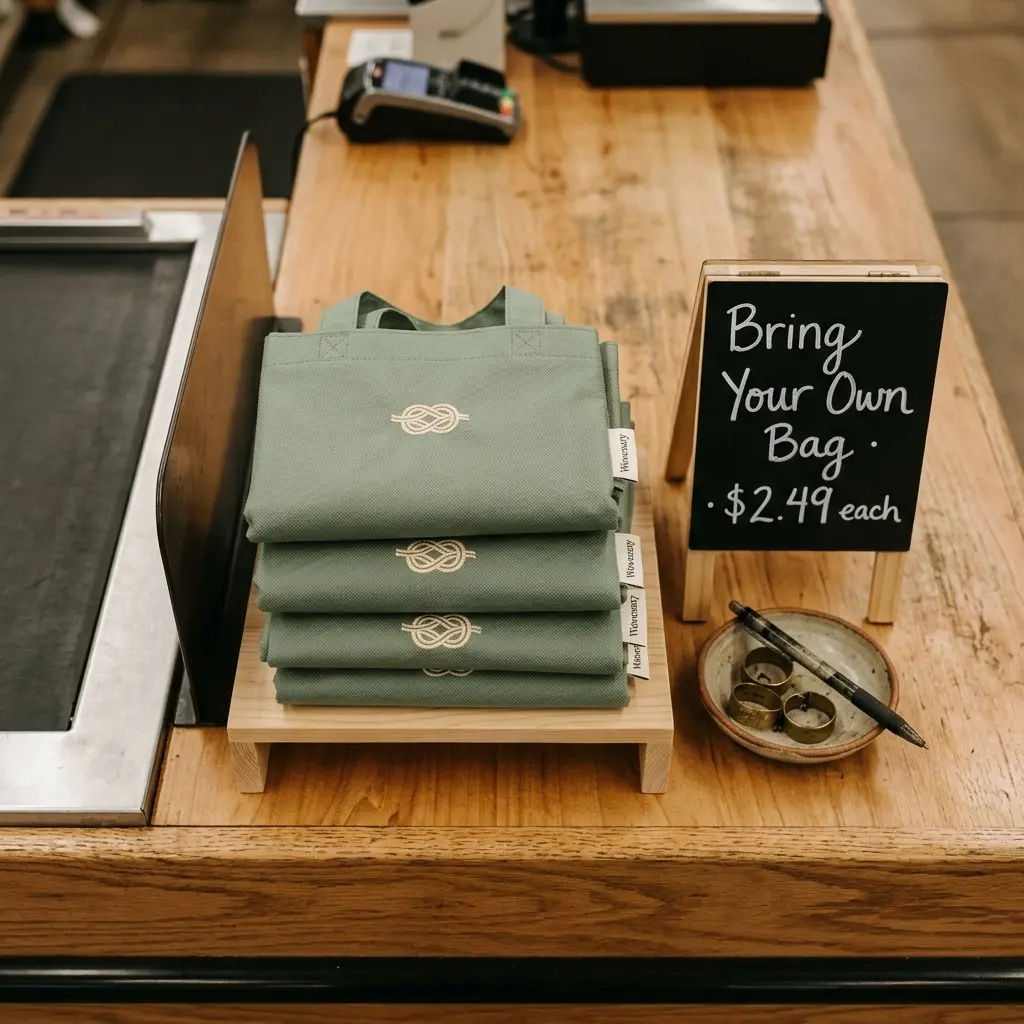
Washington DC's bag rule is the most-cited bag policy in the country — and the one most often described incorrectly. People call it a "5¢ tax." It's actually a fee, structured very differently from the bag taxes in Chicago or the bans in California. For DC retailers, the practical compliance read is short: charge the 5¢ on disposable carryouts, exempt customer-supplied or merchant-sold reusables, remit through the standard sales tax cycle, move on.
This guide walks through what the rule actually says, what reusables we ship into DC, and how DC stacks against the surrounding jurisdictions in MoCo, PG County, and Northern Virginia.
The 60-second answer
DC's Anacostia River Clean Up and Protection Act of 2009 charges 5¢ per disposable carryout bag at any food-selling retailer in the District. Retailers retain 1¢ per bag, remit 4¢ to the Office of Tax and Revenue (5¢ if they choose not to participate in retention). The rule has been in effect since January 1, 2010. Plastic carryouts that don't meet specific durability standards are not banned outright but carry the fee. Reusable bags that meet DC's durability test — stitched handles, machine-washable fabric or durable non-film plastic, intended for multiple reuse — are exempt from the fee.
In our DC customer orders, the dominant compliance path is to skip the disposable mechanic entirely by sourcing branded reusables (typically 100 GSM non-woven PP or 12oz cotton canvas) and selling them as merchandise or providing them as free carryouts where brand strategy supports it.
What "food-selling business" actually covers
The rule applies to any DC business that sells food. That's a wider net than just grocery stores. The covered list includes:
- Grocery stores and supermarkets
- Convenience stores and corner stores
- Pharmacy and drugstores (if they sell food, which almost all do)
- Liquor stores
- Restaurants and bars (for takeout / off-premises carryouts)
- Coffee shops and bakeries
- Hotel gift shops and convenience marts (if they sell food)
- Farmers' markets and food trucks (with separate enforcement)
Non-food retail (clothing boutiques, hardware stores, bookstores) is not subject to the DC bag fee. The split sometimes creates oddities at multi-category retailers — a museum gift shop that sells coffee falls under the rule, but a museum gift shop that only sells merchandise does not.
What we ship into DC
Across roughly 25 DC-area customer accounts we shipped in 2025–2026, the order patterns broke down like this:
| Bag style | Landed cost (DDP) | Typical DC use case |
|---|---|---|
| 100 GSM woven PP, stitched handles, single-color print | $0.65–$0.95 | Bodega and convenience resale at $1.99 retail |
| 120 GSM laminated BOPP, full-color CMYK | $0.85–$1.20 | Premium grocery and natural-foods chains |
| 12oz cotton canvas, screen print | $1.85–$2.40 | Specialty grocers, coffee shops, museum gift shops |
| 12oz cotton canvas, embroidered logo | $2.20–$2.80 | Restaurants positioning the bag as branded gift |
The 100 GSM woven PP at $0.65 landed and $1.99 retail is the workhorse — that single spec covers ~60% of the DC volume we ship. The math is simple: a 5¢ fee on a paper bag is a small friction at the register, but the reusable at $1.99 with a logo customers actually want carries margin and brand impression. Most DC retailers we work with treat the reusable program as net-positive within 90 days.
DC vs the surrounding jurisdictions — what's actually different
DC is fee-based. The two MD counties next door run different frameworks. The simplest way to think about it:
- DC (Anacostia Act, in effect since 2010): 5¢ fee on disposable paper or non-compliant plastic carryouts at food-selling businesses. Plastic not banned outright. Retailer retains 1¢, remits 4¢.
- Montgomery County (BYOB Law, in effect January 1, 2026): 10¢ fee on paper carryouts at adopting municipalities. Plastic carryout banned in adopting municipalities. Retailer retains 5¢, remits 5¢. Reusable definition: stitched handles, 125-use, 80+ GSM.
- Prince George's County (Better Bag Bill CB-32-2023): Separate Better Bag Bill framework — confirm current effective date and fee against the PG County DOE before publishing customer-facing material.
- Northern Virginia (VA Code § 58.1-1745): 5¢ tax on disposable plastic in the counties that have opted in (Fairfax, Arlington, Loudoun, Falls Church, Alexandria adopted; most other VA counties have not).
For retailers operating across DC + MoCo + Northern Virginia, sourcing a single compliant reusable line that clears the strictest spec (MoCo's 80+ GSM stitched-handle floor) and using it across all three jurisdictions is the procurement move. The unit-cost penalty for over-speccing for DC and VA is trivial; the documentation simplification is worth it.
When to source reusables for your DC program
Two windows we typically recommend:
- Q4 / early Q1. Most DC food-selling retailers reset bag inventory ahead of Q1 budget cycles. Order by late October for January delivery (ocean from Pakistan).
- Late spring. Tourist season retail prep in DC drives a secondary pull. Order by late April for July delivery.
For new openings or rebrands, the lead time from artwork approval is 7–9 weeks ocean / 3–4 weeks air freight at a per-unit uplift.
Request a DC-area wholesale bag quote — we'll review your requirements and follow up with landed cost, compliance documentation, and a recommended SKU mix for your store type.
— Annem Zaidi, Co-founder, Wovenary
Frequently asked questions
What is the DC bag fee?
Are plastic bags banned in DC?
What reusable bag specs work for DC?
Does the 5¢ fee apply to restaurant takeout in DC?
How does DC compare to Montgomery County and Prince George's?
What if my DC store is in a non-participating Business Improvement District?
Have a program to scope?
Send your specs and quantity for a free, all-in DDP quote. We'll confirm artwork needs and next steps with you.
Get a free quote