
Canvas vs Non-Woven vs Cotton: Which Wholesale Bag Fabric Wins in 2026
A procurement comparison of canvas, non-woven polypropylene, and cotton — cost per unit, durability, imprint methods, sustainability, compliance, and which wins for each use case.
Key takeaways
Get a quote for canvas, non-woven, or cotton bags →
- Non-woven PP wins on price ($0.55–$1.60/unit) for high-volume, short-life giveaways — trade shows, conference totes, grocery promos.
- Canvas (10–16oz) wins durability at 200+ uses — the right call for reusables, retail gift-with-purchase and premium gifting.
- Cotton muslin fits budget natural-fiber programs (wine, favor and produce bags) at 20–40 uses.
- Two hard rules: never sublimate cotton or canvas, and spec 80+ GSM stitched non-woven for any bag-ban market.
Every wholesale bag program resolves to a material decision, and most buyers over-think it. The three dominant fabrics — canvas, non-woven polypropylene, and cotton — each own a clear use case, and the wrong choice in either direction wastes money (over-spec) or brand equity (under-spec). This article lays out the decision framework we use on every quote.
The quick-reference comparison
| Attribute | Canvas (10-16oz) | Non-Woven PP | Cotton Muslin (6-8oz) |
|---|---|---|---|
| Price / unit @ 1,000 | $1.80-$3.50 | $0.85-$1.60 | $1.10-$2.00 |
| Price / unit @ 10,000 | $1.35-$2.40 | $0.55-$0.95 | $0.85-$1.40 |
| Lifespan (typical uses) | 200+ | 50-80 | 20-40 |
| Best imprint method | Screen print, embroidery | Screen print (plastisol) | Screen print, DTF |
| Best for | Retail GWP, premium gifting, reusables | Trade shows, high-volume giveaways | Budget promo, muslin wine bags |
| Bag-ban compliant? | Yes (all weights) | 80+ GSM stitched only | Usually yes |
| Sustainability angle | Reusable, natural fiber | Low-impact per unit, recyclable PP | Biodegradable, natural fiber |
| Primary origin (2026) | Pakistan | Pakistan | Pakistan, India |
Canvas: when to spend the extra dollar
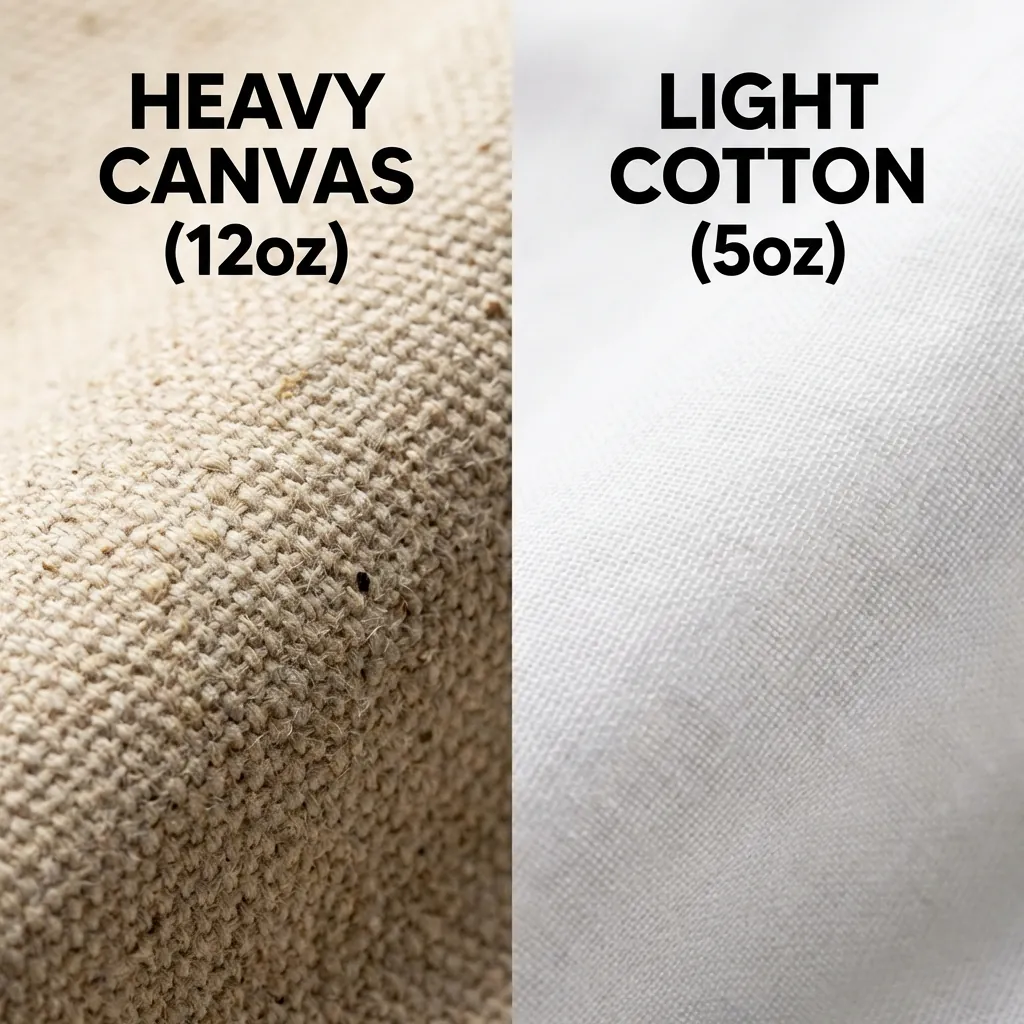
Canvas wins when the bag needs to survive reuse and the brand wants a premium feel in the recipient's hand. It is the correct choice for corporate gifting, retail gift-with-purchase (GWP), executive onboarding kits, and any reusable-bag program where the bag itself is meant to function as durable advertising.
The price premium — roughly 2x-3x over non-woven — buys three things: fiber weight (10-16oz cotton canvas vs. 70 GSM non-woven is a completely different tactile experience), construction quality (reinforced seams, boxed corners, webbed handles), and imprint fidelity (canvas holds water-based ink beautifully).
Where canvas loses: short-horizon handouts. If the bag's job is to survive one trade-show evening and then get tossed, spending $2.00 a unit to make it feel like a retail accessory is wasted budget. Non-woven is the right answer there.
Default origin: Pakistan. The Punjab textile corridor produces canvas at consistent weight and finish at a better FOB than Chinese equivalents — and with Section 301 duties factored in, the landed gap is 25-40% in Pakistan's favor. We cover the full tariff math in our Section 301 tariffs guide.
Non-woven: when the math is about volume
Non-woven polypropylene is purpose-built for high-volume, low-unit-cost programs where the bag needs to be cheap enough that over-ordering by 20% doesn't break the budget. Think conference tote-bags, grocery-promotion bags, ballot-style voter handouts, university onboarding kits.
The material is printable, lightweight (a 100-GSM tote weighs 4-5 ounces empty versus a canvas tote at 10-14 ounces), and cheap to freight. On a 25,000-unit program, non-woven saves $0.90-$1.50 per unit versus canvas — which is $22,500-$37,500 on a single run.
Where non-woven loses: bag-ban compliance for some jurisdictions. The rules vary. Montgomery County MD requires stitched handles plus 4.0+ mil thickness. California's SB 270 reusable-bag law requires 2.25+ mil and minimum reuse testing. Most 80+ GSM stitched non-woven bags clear these bars; cheaper 40-60 GSM ultrasonic bags typically do not. If your distribution zones include bag-ban markets, spec the higher GSM from the outset.
Default origin: Pakistan. Section 301 puts Pakistan at 5-8% duty versus China's 12-15% on non-woven. For a 25,000-unit run, that routing saves several thousand dollars on duty alone.
Cotton muslin: the overlooked middle ground
Cotton muslin is the fabric that gets skipped in procurement conversations because it doesn't have an obvious champion. But it wins a specific, valuable slice: budget-constrained natural-fiber programs.
Common use cases: wine muslin bags for retail gift packaging, drawstring favor bags for weddings and events, reusable produce bags, small jewelry or beauty-product bags. At 6-8oz, cotton muslin is lighter and cheaper than canvas while still presenting as a natural, biodegradable fiber — which buyers of certain categories value.
Where cotton muslin loses: durability. A 6oz cotton bag handles 20-40 uses. For any program expecting sustained reuse (grocery, everyday retail), spend the extra $0.40-$0.60 per unit for 10oz canvas.
Default origin: Pakistan or India. Both have mature cotton supply chains and sit in the same 5-8% duty band.
Imprint method × fabric matrix
Imprint technique is not independent of fabric; certain methods only work on certain substrates. Here is the working matrix:
| Fabric | Screen Print | DTF | Embroidery | Sublimation | Debossing |
|---|---|---|---|---|---|
| Canvas 10-12oz | Excellent | Excellent | Good | Not recommended | Good (heavy weights) |
| Canvas 14-16oz | Excellent | Good | Excellent | Not recommended | Excellent |
| Non-woven PP | Good (plastisol) | Good | Not recommended | Not recommended | Not recommended |
| Cotton muslin 6-8oz | Excellent | Excellent | Good | Does not bond | Not recommended |
Key don't: never specify sublimation on any cotton or canvas bag. Sublimation bonds only to polyester; on cotton substrates the imprint washes out within 2-3 cycles. If a vendor recommends sublimation for a cotton tote, their process knowledge is suspect. For more on the full imprint landscape, see our tote bag printing methods guide.
The sustainability scoreboard
"Sustainable" is a marketing word that means different things depending on measurement. For buyers publishing ESG or scope-3 reports, the useful frame is lifecycle impact per use.
- Canvas (reusable, natural fiber). High production footprint per bag (cotton is water-intensive) but 200+ uses spread that footprint thin. At 100+ uses, canvas has the lowest impact-per-use of the three.
- Non-woven PP. Low production footprint per bag but petroleum-derived and only 50-80 reuses. Recyclable where PP recycling infrastructure exists (mostly urban centers).
- Cotton muslin. Biodegradable and natural, but lighter weight limits reuse count. Best sustainability claim: "biodegradable promotional packaging" rather than "reusable."
If you are marketing to a sustainability-sensitive audience, canvas with a reusable-bag narrative is the cleanest story. If you are meeting an internal ESG target without a consumer narrative, recycled-content non-woven (rPP) or recycled cotton is cheaper and defensible.
The 30-second decision tree
Three questions to arrive at the right fabric:
1. How many uses does the bag need to survive?
- 1-10 uses → non-woven
- 10-50 uses → cotton muslin or light canvas (10oz)
- 50-200+ uses → canvas (12-16oz)
2. What is the budget per unit at your target quantity?
- Under $1.00 → non-woven
- $1.00-$1.80 → cotton muslin or light canvas
- $1.80-$3.50+ → canvas with choice of weight and handle spec
3. Does distribution include bag-ban markets?
- Yes, high-volume → canvas (safest across jurisdictions) or 80+ GSM stitched non-woven
- Yes, selective → cotton or canvas by default
- No → pick on budget and reuse count
Frequently asked questions
What is the cost difference between canvas, non-woven, and cotton wholesale bags?
Which fabric lasts longest?
Which fabric is best for screen printing?
Is non-woven polypropylene compliant with bag-ban regulations?
Which fabric has the lowest environmental footprint?
Can I get custom sizing in all three fabrics?
Which fabric is best for grocery and retail checkout?
What is the typical lead time for each fabric?
Brief us on your fabric decision
We'll sample your top two candidates against each other at your actual spec. Sample kits ship in 2-3 days from Bethesda, MD — feeling 10oz canvas against a 100-GSM non-woven settles the debate in one meeting.
Get a free quote