Start with one piece you want to sell
Picture the person wearing it. A summer market tee should feel comfortable outside. A boxy streetwear tee needs enough body to hold its shape. Choose one product, one lead color and the first place you expect to sell it. A favorite garment and a photo of the fit you like are enough to begin.
Can sizes and colors share a minimum?
Ask which minimum applies to the style, fabric color and artwork. For example, 50 tees in one color across five sizes and 25 each in two colors are different production briefs. List your size split and ask which combination qualifies before taking preorders.
Work backward from your selling price. Add garments, decoration and setup, samples, labels, packing, freight, duties and delivery. Divide by the pieces you expect to sell, allowing for samples and any giveaways. Compare that cost with the amount left after selling fees. Ask for air and sea options if your date is flexible. See what Wovenary’s prices include.
A first-run example. Say 50 tees cost $600 in total to make and land. If you keep five for photos and samples, you have 45 to sell. Dividing $600 by 45 gives $13.33 per sellable tee before selling fees. Use your own quoted costs in that calculation.
What does GSM tell you?
GSM means grams per square meter. A square meter of 180 GSM jersey weighs 180 grams. The number describes the fabric’s weight per area. Knit, fiber, wash and fit also affect how the finished garment hangs. Compare two swatches of the same knit when judging weight.
These are example weights to sample. Wovenary confirms availability for your fabric and color. If a mill quotes ounces per square yard, 1 oz/yd² is approximately 33.9 GSM.
Choose the fiber mix and the knit
- 100% cotton jersey
- A familiar tee fabric with a smooth face. Check the actual sample for softness, opacity and size change after washing.
- Cotton and polyester
- An 80/20 cotton/poly blend means 80% cotton and 20% polyester by fiber weight. A 50/50 blend has equal amounts. Compare swatches for drape, drying feel and pilling. Ask which fiber is on the outside where the artwork goes.
- Cotton with elastane
- A small elastane content can add stretch and recovery to a fitted tee. Stretch the decorated sample where the logo sits and see how it returns.
- French terry or brushed fleece
- Look inside the sweatshirt. French terry has visible loops. Brushing raises those fibers into a soft, fuzzy surface. Either can be cotton or a blend, and samples at the same GSM can feel quite different.
Screen print, DTF or embroidery?
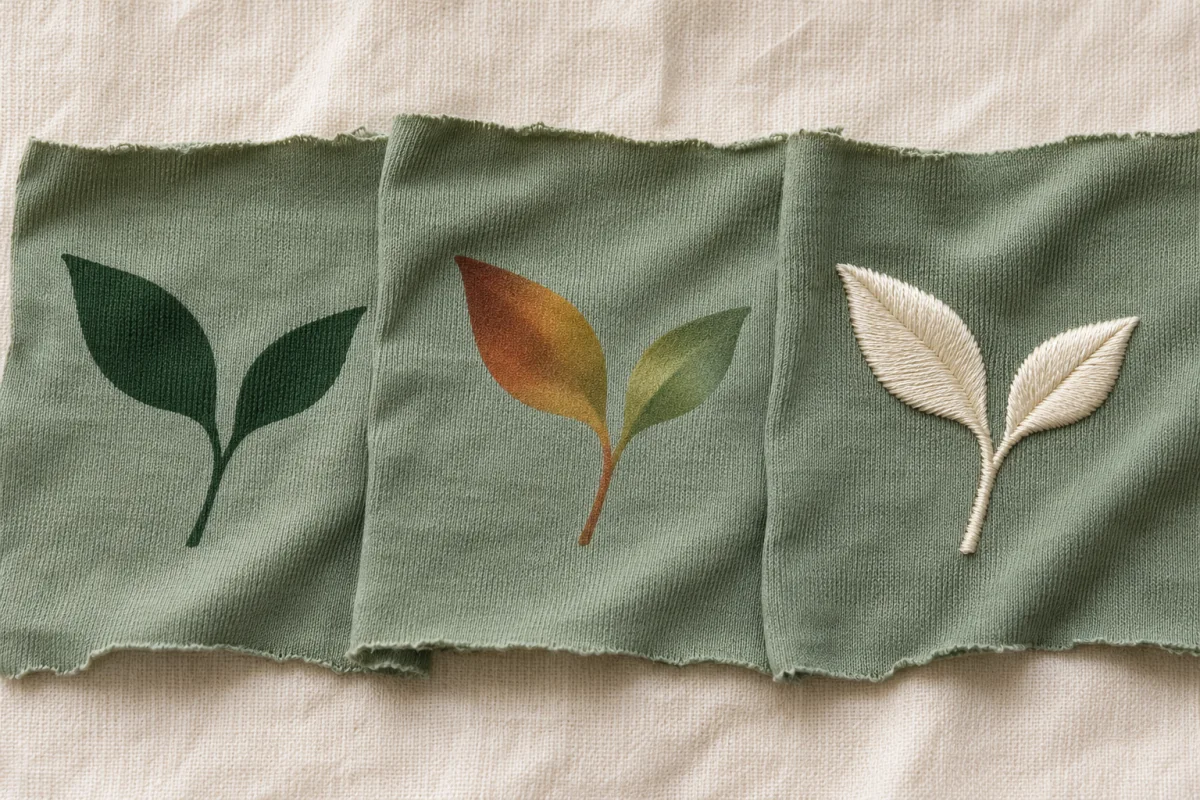
Use your artwork at its actual size to choose. Ask to see the decoration on the same fabric and color as your order.
Screen printing
Ink passes through a mesh screen onto the fabric. A bold, one-color back print is a good starting point. Each spot color usually needs a separate screen, so setup gets spread over more units on a repeat design.
Ask for a print sample, ink feel and setup cost for your color count.
Direct-to-film (DTF)
A design is printed on film and transferred with heat and pressure. Fine multicolor artwork or a short run can suit DTF. A large solid print can feel like a continuous layer across the chest.
Ask for a transfer at final size. Feel it, stretch it gently and wash it on the chosen fabric.
Embroidery
A machine stitches the design in thread. It suits a compact chest mark on a stable fabric. Tiny lettering may need simplifying. Dense stitching can pull on a lightweight tee.
Ask for a stitched trial, called a sew-out, plus any digitizing charge. Check the reverse against your skin.
Approve the sample before the run
- Try it on. Measure the relaxed chest width and body length. Check the fit on the people you expect to buy it.
- Wash and remeasure. Follow the proposed care instructions. Check twisting seams, shrinkage, pilling and how the print or stitching looks.
- Record the version. Photograph the approved piece, mark artwork width and placement, and confirm the fabric, color, labels and size split in writing.
- Separate the dates. Ask for sampling, production after approval, dispatch and arrival. For one planning example, Wovenary typically allows about one week for tee sampling and two weeks from sample approval to dispatch for 100 shirts. Transit is additional. Your quote confirms the schedule.
For a more involved garment, see the jacket brief and size worksheet. The Soof Solutions vest order shows how an event and a logo placement shaped a real brief.
An editable example
What a first brief can look like
This example carries into the quote form. Replace the details with your own. A reference photo is useful if you have one.
I’m planning an everyday tee for my first collection. Please quote 50 tees in one color, split S 8, M 16, L 16 and XL 10. I’d like to compare 180 and 200 GSM cotton jersey. My artwork is a one-color chest print, about 3 inches wide. Please separate sample, setup, bulk and shipping costs. I’ll confirm my delivery ZIP code and target date.
Prepared by the Wovenary team on . Technical references include Gildan’s fabric guide (PDF), STAHLS’ decoration comparison (PDF) and Printful’s embroidery digitizing guide.