
Factory-Direct vs Promotional Distributors: The Real Cost Math
What 1,000 canvas totes actually cost from a factory-direct supplier versus 4imprint, Custom Ink, BagzDepot, or ToteBagFactory — laid out line by line, with the decision tree for when each model wins.
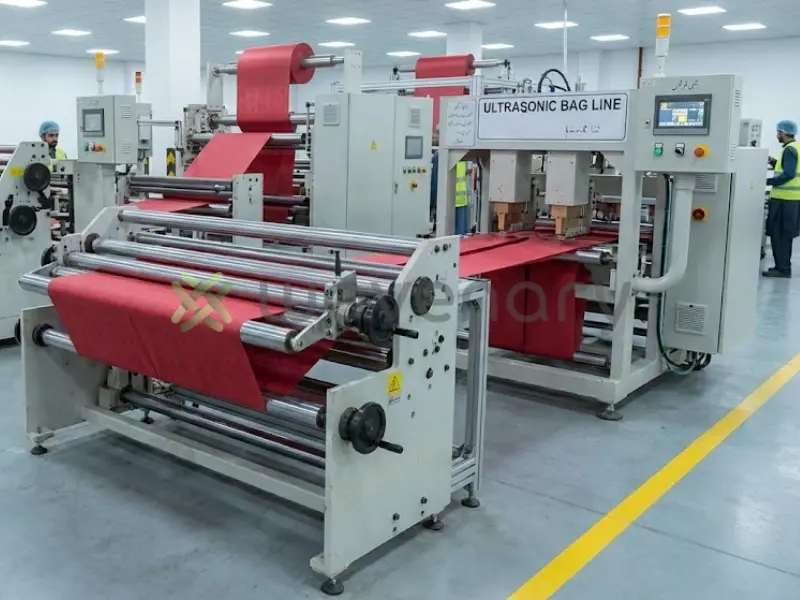
Most B2B buyers I talk to start the supplier conversation with the wrong question. They ask "factory-direct or distributor?" as if it's a binary. It's actually three variables: order size, lead time tolerance, and program duration. Once you map those, the answer falls out.
This guide is the framework I use when a procurement lead at a school district, a hotel group, or a retail brand asks us how we compare to 4imprint or Custom Ink for their custom-bag program. The numbers below are from our own 2025–2026 quote audit against named competitors — not market-research estimates.
The 60-second answer
Factory-direct wins on cost and quality control at 500+ units when you can absorb a 7–9 week first-cycle lead time. Distributors win on speed and low-MOQ flexibility under 250 units. There's a middle band — 250–500 units — where the call depends on whether the program will repeat.
If you're running a single-event giveaway under 200 units with a 2-week timeline, stop reading and use a distributor. We won't be the right answer.
If you're running an ongoing program, building a stocked SKU, or sizing an order at 1,000+ units, factory-direct will save you 25–40% on landed cost and you'll get documentation distributors can't supply.
What the distributor model actually is
Every promotional-products distributor I've audited fits one of two patterns:
- Import + drop-ship. They place a master order at an Asian factory (or several Asian factories), warehouse blank inventory in the US, and print-on-demand when an order comes in. 4imprint, Custom Ink, BagzDepot all run variants of this model. Their cost line is: factory FOB + ocean + warehousing + print-on-demand setup + 25–45% margin.
- Pure-broker. They take the customer order and place a custom order at the same Asian factory we'd use, with a 30–50% margin on top. Smaller "manufacturers" with no factory of their own typically operate this way.
Both models add value — US-side customer service, lower-MOQ flexibility, faster fulfillment on stock SKUs, no procurement-side complexity for the buyer. Both also cost the buyer 30–45% more than factory-direct on the same SKU at the same volume.
The cost math, line by line
Here's what 1,000 units of a custom 12oz canvas tote (13 × 15 × 4 inch, stitched handles, one-color screen print) cost from a distributor versus from us in 2026:
| Cost line | Distributor (typical) | Wovenary factory-direct |
|---|---|---|
| Bag unit cost | (hidden — included in price) | $1.05 FOB Pakistan |
| Ocean freight + duty | (included) | $0.32 per unit allocated to order |
| US warehousing | (included) | n/a — DDP to your dock |
| Print setup + plates | $40–$80 setup + $0.45/unit | $35 setup + $0.18/unit |
| Per-unit landed (1,000 units, 1-color print) | $2.65–$3.10 | $1.85 |
| Margin / overhead built in | 30–45% | 18% (factory + Wovenary US team combined) |
| Lead time | 5–10 days (US stock) | 7–9 weeks first cycle, 4–5 weeks reorder |
On a 1,000-unit order, factory-direct saves the buyer $800–$1,250 on a single run. On a 10,000-unit national rollout, the savings range $8,000–$12,500. On a 50,000-unit annual program, $40,000–$62,500.
This is also where the documentation gap shows up. Distributors don't typically provide HTS code documentation, material spec sheets, heavy-metal certs, or named factory traceability. We default to all of it because we're the importer of record.
The decision tree
Ask these four questions in order:
1. How many units in this order?
- Under 100: distributor (Custom Ink, 4imprint, or local screen-printer)
- 100–250: distributor for one-off, factory-direct if the program will repeat
- 250–500: factory-direct if quality matters, distributor if speed matters
- 500+: factory-direct, full stop
2. What's the lead time?
- Under 14 days: distributor, period
- 14–30 days: distributor or factory-direct air-freight (premium pricing)
- 30+ days: factory-direct
- 45+ days (the normal case): factory-direct
3. Will this repeat?
- One-off: distributor or factory-direct on a single run
- 2–4× per year: factory-direct, build a relationship and stock blanks
- Continuous (stock SKU): factory-direct only — the distributor margin compounds
4. Do you need traceability or compliance documentation?
- No: distributor is fine
- Yes (FDA, school district procurement, hospital GPO, ESG/sustainability reporting): factory-direct, and ask for the documentation package up front
If the answers point to factory-direct on three of four, the math works.
The reorder advantage
Here's the part most procurement leads underweight on first conversation: second cycle is the real test, not first.
On a typical first-time factory-direct order, the buyer is paying for: artwork iteration, sample lead time, the first production run, ocean freight, and customs. Total cycle: 7–9 weeks.
On the reorder, none of that resets. The artwork is approved. The sample is approved. The factory has the pattern, the print plate, and the spec on file. If we've pre-staged blank inventory at our Bethesda warehouse — which we do for most repeat clients — we can pull-print and ship within 5–10 days. Reorder lead times match or beat distributor stock fulfillment, at 25–40% lower unit cost.
This is also why I tell first-time buyers to start with their largest planned order, not their smallest. Build the relationship around real volume, and the math gets dramatically better starting from cycle two.
Where distributors are genuinely better
I run a factory-direct supplier. I also send buyers to distributors when it's the right call. The scenarios I refer out:
- Sample sizes under 50 units. 4imprint and Custom Ink will take 24-unit minimums on plain bags. We won't quote below 200 units on most SKUs because the procurement overhead doesn't pencil for either side.
- Same-week event giveaways. If the trade show is in 10 days, I can't physically get a custom bag to your door from Pakistan unless we air-freight, and at that point the per-unit cost crosses what a distributor would have charged anyway.
- Existing stock SKUs. Distributors keep popular bag styles in stock with stock artwork available. If you don't need custom — just a logo on a known blank — distributor stock is faster and competitive.
- Print-on-demand for very low quantity. Custom Ink and ShortRunPosters do single-unit fulfillment with reasonable economics. We can't.
Outside those, factory-direct wins on three or four of the four decision-tree questions for most B2B programs we see.
When to talk to us
If your annual program ships 5,000+ units across one or more SKUs, the conversation is worth having. We review RFQs and prepare a full landed-cost breakout (FOB, freight, duty, allocated overhead) — not just a "price per unit" number that hides where the margin sits.
If you're not sure where your program falls, send the RFQ anyway. The first 15 minutes of the conversation typically clarifies whether we're the right answer or whether one of our distributor competitors is. I'd rather lose the quote than win the wrong customer.
Request a wholesale quote from Wovenary — free landed-cost quote, sample lead time confirmed for your brief, no obligation.
— Ibrahim A Samad, Co-founder, Wovenary
Frequently asked questions
When does a promotional distributor (4imprint, Custom Ink, BagzDepot) actually win?
How much does the 'middleman' actually mark up?
Isn't factory-direct slower?
What about MOQ? Distributors take 24 units, factories want 1,000.
Are distributor totes lower quality?
What if I'm not based in the US? Does factory-direct still work?
How do you handle artwork and proofs without a US account manager?
What documentation do I get?
Have a program to scope?
Send your specs and quantity for a free, all-in DDP quote. We'll confirm artwork needs and next steps with you.
Get a free quote